Digital twins are not new. For years, industries such as manufacturing and aviation have created virtual replicas of machines, engines and complex systems. These digital models continuously receive real-world data, helping engineers predict failures, test alternatives and optimize performance.
Now imagine applying the same principle to something infinitely more complex. A human being. This is the emerging idea of a Medical Digital Twin.
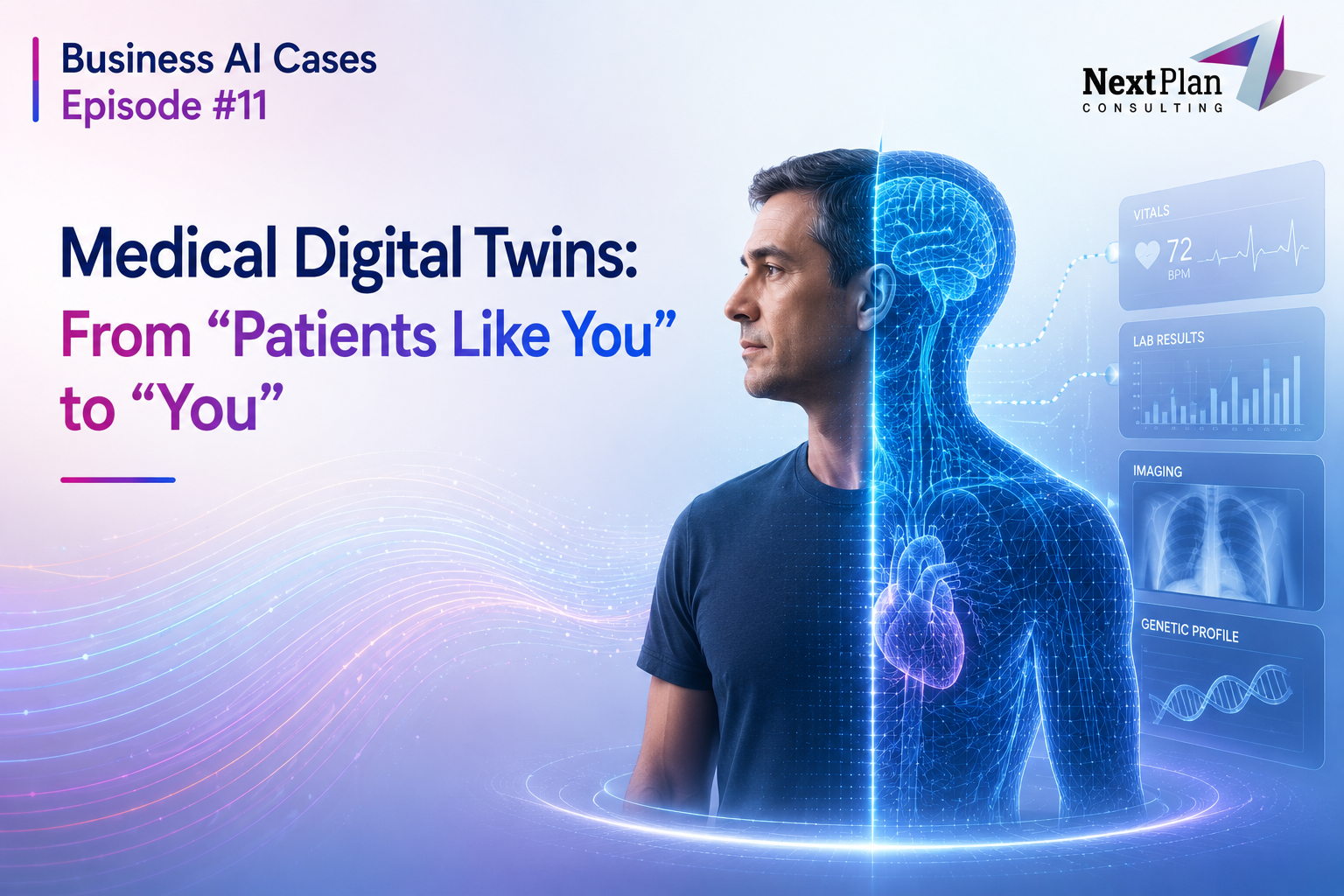
Stanford Medicine describes it as a dynamic virtual representation of a patient, continuously informed by data such as medical history, laboratory results, imaging, genetic profiles and wearable-device outputs. The model can potentially simulate biological processes, predict disease progression and evaluate treatment responses.
Think about what this could mean for medicine. Much of today's clinical evidence tells us what happened to populations of patients. A particular treatment worked in 65% of patients. A certain risk factor increased disease probability etc. All extremely valuable.
But the question confronting the physician is different:
What is most likely to happen to THIS patient? Medical digital twins could help bridge that gap.
Instead of choosing a treatment and waiting to see how the patient responds, clinicians could potentially test different scenarios on the patient's virtual twin first. What happens with Treatment A v/s B? How might this disease progress over the next year? Early applications are already emerging.
The Stanford Medicine describes aspects of digital twins being used in adaptive-therapy clinical trials for cancer, where patient-specific information helps dynamically adjust treatment. In diabetes, AI-driven digital-twin approaches can use continuous glucose-monitoring data to help personalize insulin dosing. The implications go beyond treatment selection.
Digital twins could potentially move healthcare from reactive to predictive and preventive care—identifying changes before symptoms become obvious and enabling earlier interventions.
For pharmaceutical and healthcare leaders, this opens some fascinating questions. What happens to treatment guidelines when patient-level prediction becomes increasingly sophisticated? How will clinical trials evolve?
Could therapies eventually be evaluated not just for patient segments, but against individual biological profiles?
And how will pharma communicate value when the question moves from “Does my drug work?” to “Will my drug work for this particular patient?”
We are certainly not there yet. But the direction is fascinating.
Medical Digital Twins could take us one step further—from treating patients like you, to treating YOU.