We have spent the last 13 episodes exploring what Artificial Intelligence can do.
But perhaps business leaders should now ask another question: How much of that potential are we actually using?
Recent research from Anthropic provides an interesting answer.
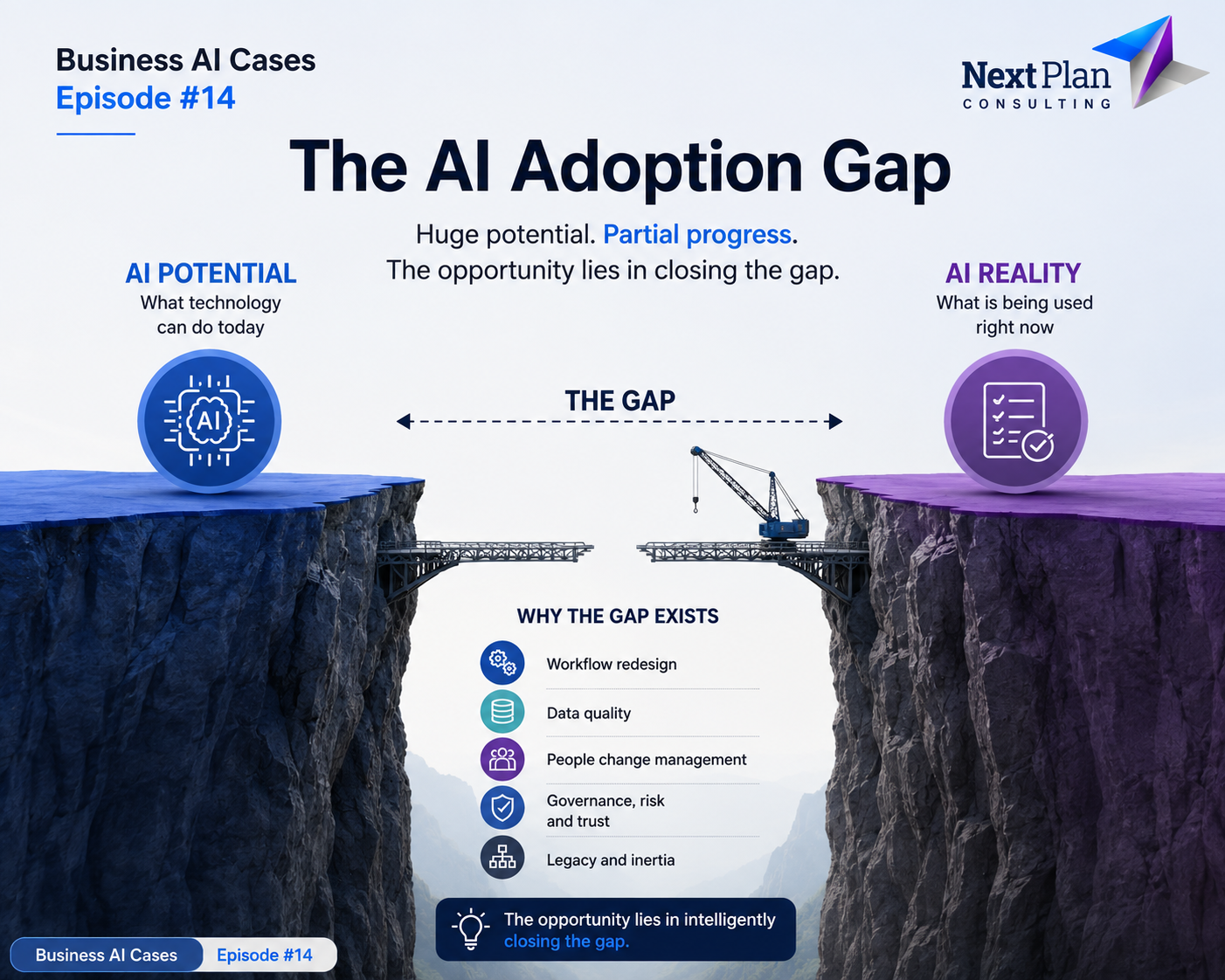
The researchers compared two things across occupations: Theoretical AI Coverage — tasks that today's LLMs could potentially perform or significantly accelerate versus Observed AI Coverage — tasks where AI is actually being used in professional settings.
The gap is striking.
In Computer & Math occupations, AI could theoretically influence around 94% of tasks. Yet Anthropic currently observes coverage of only about 33%. Similar gaps appear across Management, Business & Finance, Legal, Architecture & Engineering and several other knowledge-intensive professions.
The message is important.
AI capability is currently running far ahead of organizational adoption.
Why?
Technology alone doesn't create transformation. Workflows need redesigning. Data needs organizing. Systems need integration. Employees need new capabilities. Governance needs to be established. And organizations need confidence that AI-generated work is reliable enough for actual business use.
The pattern also tells us where change may happen fastest.
Knowledge-intensive, information-heavy and computer-based work shows considerably greater AI potential than jobs dominated by physical activity.
Think about a pharmaceutical company function by function. Marketing teams spend considerable time analyzing markets, creating communication, developing brand plans and reviewing data. Sales managers analyze performance, prepare reviews and coach teams. Medical teams search literature, synthesize evidence and respond to scientific queries.
HR, Finance, Training and Business Excellence teams perform numerous information-intensive tasks. R&D teams increasingly combine scientific expertise with massive datasets. Many of these activities sit exactly where AI has high potential.
But this does not mean these jobs disappear.
Anthropic's early evidence finds no systematic increase in unemployment among highly exposed occupations since late 2022, although there are early indications that hiring of younger workers into exposed occupations may be slowing.
Perhaps the more immediate question for business leaders is therefore not:
“How many jobs can AI replace?” It is: “How much of the work inside every job can AI improve?”
For pharma companies, the opportunity is to create an AI Opportunity Map: Which functions have the greatest potential? Which tasks within them can be augmented today? Where can AI automate entire workflows? And where must human judgment remain firmly in control?
The business opportunity lies in intelligently closing the gap between potential v/s reality.